
Yes, it's been super quiet here at the Upskill blog. I actually never posted in 2014. Is that bad?
On a positive note, I have been doing heaps of climbing. The 2013 and 2014 seasons are some of the most fun climbing I've had in the SE Queensland region, ever. You know I love new routing. For those two years, all my energy outside work was funneled into developing three major new cliffs in the Urbenville region of northern NSW: Vesuvius, Spot X and Crossroads.
Between the three crags, we established 71 routes. 20+ of these were over 40m in length. It was epic.
All this action is a mere two hour drive from Brisbane. I put lots of k's on the car. But so, so worth it. All info for all three crags is now available on theCrag.com, and the season is just starting. If you live in Brisbane, 2015 could be your Urbenville year. It's the Catalunya of Queensland.
I capped off both prolific seasons with a hard first ascent. The second of these was Vixen 32. I was really pleased to vision, and then eventually climb this extremely overhanging, blank looking wall. The movement on it is super good - one of the most fun routes I've done. Erik filmed on it using his ingenious RopeClimber camera, and EpicTV ended up picking up the video. 200,000+ views later, and lots of people have now seen Spot X, even if they'll never climb there. Watch the vid.
Looking
for the ideal sport route lower-off configuration is like a quest for
the holy grail. There are so many different setups and configurations,
and generally, they all generally have some advantages and
disadvantages.
Let's look at a few different configurations for pro's and con's.
 |
| A custom chain setup. |
Expense: Bad. High cost due to number of components.
Rope-twist factor: Good. Low.
Lifespan: Good. Where the rope touches are rings which spin, spreading the wear.
Replace-ability: Good. Mallions attach the chains.
Convenience: Bad (no clip and lower).
Single clip safety: Bad. Ideally you want to clip to the anchor and be immediately attached to two bolts.
 |
| Horizontal Fixe rings - quite common setup. |
Expense: Not bad.
Rope-twist factor: Not great. Even if this was threaded correctly (not like the photo) this configuration does twist the rope.
Lifespan: Good. Where the rope touches are rings which spin, spreading the wear.
Replace-ability: Good. Tru-bolts have been used (the only time I recommend their use!) to enable the anchors to be removed and replaced.
Convenience: Bad (no clip and lower).
Single clip safety: Bad. Ideally you want to clip to the anchor and be immediately attached to two bolts.
 |
| Commercial Fixe anchor set. Very common. |
Visual impact: Moderate.
Expense: Moderately expensive.
Rope-twist factor: Good. Single ring sits perpendicular to the wall. No rope twist.
Lifespan: Good. The rope wears the ring, which can spin and spread the wear.
Replace-ability: Not great, as you have to replace the entire anchor, or chop the ring and install an alternative.
Convenience: Bad (no clip and lower).
Single clip safety: Good - you're always on two bolts. This makes for a good multipitch anchor, and quite a good sport route lower-off, if somewhat inconvenient.
 |
| Commercial unit from 'Raumer' |
Expense: Reasonably expensive as this is a commercial product.
Rope-twist factor: Good. Lowering off a single point minimises rope twist.
 |
| Wear! |
Replace-ability: Bad. When the carabiner is worn out, it's quite a job to chop it off with a grinder. This leaves a spinning ring which you can lower off, or put another captive steel carabiner with a mallion. The other option is to replace the entire unit with an identical unit.
Convenience: Good. Clip and lower, baby!
Single clip safety: Good. You can clip anything and you're attached to two bolts.
 |
| Two naked glue-in rings. |
 |
| Wear on ugly U-bolt. Bad! |
Expense: Good. Pretty cheap.
Rope-twist factor: Not great. This configuration does twist the rope.
Lifespan: Bad. Rope-wear will wear these bolts out (see right). This anchor can be good for very low traffic routes, but as soon as wear is noticed, install some mallions and chain.
Replace-ability: Bad. Once these wear out you have to heat them with a blowtorch to melt the glue and then extract. It's pretty full-on! Lazy people would chop them but this is messy at best.
Convenience: Bad (no clip and lower).
Single clip safety: Bad. Ideally you want to clip to the anchor and be immediately attached to two bolts.
 |
| Fixe ring and chain combo. |
Expense: Moderate. There are a few components here. Cheaper than most commercial setups though.
Rope-twist factor: Good. Placed in this configuration, the thread point acts as one. Minimal twist.
Lifespan: Good. The ring will spin. The chain is easily replaced.
Replace-ability: Good. All wearable components are easily replaced.
Convenience: Not great (no clip and lower) but at least you have plenty of clip points.
Single clip safety: Bad. Ideally you want to clip to the anchor and be immediately attached to two bolts.
 |
| Glue-in rings with twist-shackles for "replace-ability" |
Why this is not good: The shackles can flip around so the rope is running over the pin of the shackle. This can undo the shackle (!!). People have tried to overcome this by "mousing" the shackles in position using wire or cable ties, but ultimately, this turns into a mess. Avoid twist shackles.
 |
| "Mussy hook" lower-off. Gaining popularity in America. This setup ticks a lot of boxes but has some drawbacks. |
Expense: Good. These mussy hooks are supposed to be quite inexpensive (available in large hardware stores like Home Depot). Beware however cast versions of these - probably from China, and strength unknown.
Rope-twist factor: Could be a big problem unless they can sit off the rock. Mike Law says "I lowered off a lot of Muzzy hooks in Owens River Gorge and they destroyed ropes by twisting, I think the fat ones have a thick spine and sit so far off the wall that rope tension pulls them over at about 45 degrees, towards each other."
Lifespan: Good. The mussy hooks have a huge rope-bearing surface and are very thick so they'll take a long time to wear to about halfway where they can be replaced.
Replace-ability: Good. The hooks are easily replaceable via the mallions.
Convenience: Great! Clip and lower!
Single clip safety: Bad. Ideally you want to clip to the anchor and be immediately attached to two bolts.
 |
| Rotating rings, replaceable! |
Visual impact: Moderate. They're very beefy, no doubt.
Expense: Moderately expensive. But everything here will last for a very long time, and will be easy to replace.
Rope-twist factor: Not as good as a single point, but not bad.
Lifespan: Superb. For starters, everything is 316 stainless, and the glue is Hilti RE-500, the best there is. The rings freely rotate, and when and if they need replacing, this is easily achieved via the mallions.
Replace-ability: Super.
Convenience: Average.
Single clip safety: Ordinarily I would rate this "bad" but in this case, I give it a "good" based on the fact it's a stainless glue-in with the world's best glue, in granite. You're good.
CONCLUSION
As you can see there is no "right answer" when it comes to sport-route anchors, but there are materials and techniques that are nearly always more appropriate than others. Route developers should always be thinking "When this anchor is worn, how easy is it to replace?"
Further reading:
To learn even more about bolting, read my 2013 updated article "How to bolt rock climbs, and how not to"
It was 1994 and I was finishing school when I first started climbing. Soon after, every request for birthday or Christmas presents was for anything climbing related. Invariably, a favourite gift was the 'Simon Carter Calendar' for that particular year. In the first one I ever had, there was a picture of a girl. A girl climbing an orange, overhanging arete. The route was called Rattler and was in a place I'd never heard of called Kalbarri in remote Western Australia. The route was grade 22 which was inconceivable at the time, but I cut out the image and put it on my wall in my university dorm and vowed I would one day go to Kalbarri to climb Rattler.
Fast forward a mere 19 years. Hectic work schedule. A long weekend possibility? A few hasty emails. Book flights. Book hire car. The team was set: the QLD squadron of JJ O'Brien, myself and Sam, and the NSW ranks of the Carter company: Simon, Monique and Coco.
 |
| Google says 51 hours by car. Perhaps we'll fly to Perth? |
On top of that, immediately before flying out, we got word that the road in to the climbing area was closed for roadworks and would stay that way for 17 weeks. Noooo! Much negotiating with the local Ranger by Simon managed to secure us a way in, but not on the road.
 |
| The way in. This is early and the sand is still damp from the dew. This is good. When the sand is white, and dry, and you're not in a Land Cruiser - you are scared! |
 |
| First view of the gorge and I am stoked! |
 |
| We're on the walk-in and Coco leads the way. |
 |
| Sam ticks Rattler (22) |
 |
| Check out The Promenade on theCrag.com |
Anyway, I somehow made it and got it done:
- Glass Slipper 29 - 2nd shot
- Homophobia 28 - 2nd shot
- Bustin' Down The Door 27 - 2nd shot
- Root Canal 26/7 - flash
- She Magic 26 - flash
- Super Funky 25 - 2nd shot
- Fuck The Law 25 - 3rd shot!
- Heavy Petting 25 (maybe 23/4?) - onsight
- It's A Boy 24 - onsight
 |
| This cut-loose and clip sequence was on the flash of Root Canal 26/7. Hope this doesn't induce seizures or vomiting. |
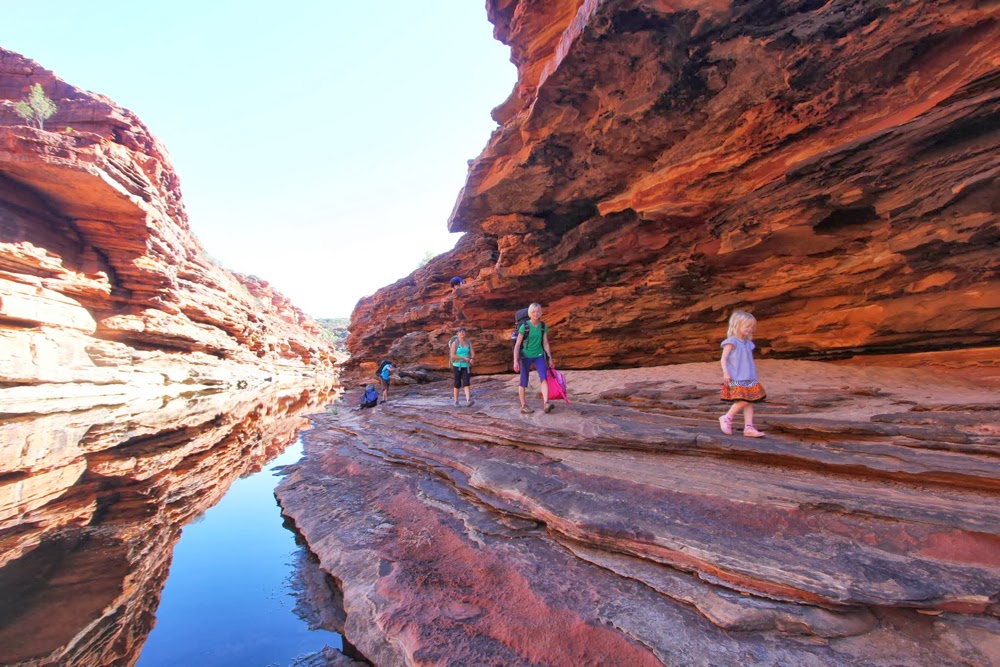
What really stuck me about Kalbarri was the rock. I loved the perfect, clean rock shelves to belay from. No need for rope bags here. I loved the different textures in the rock, and the deep rich oranges. This is ancient, ancient sandstone - over 300 million years old. The sun was blazing but we were cool in the shade.
 |
| Rock texture instagram |
 |
| Discovering the rock on Crankshaft 24 |
 |
| Sam on Obscene Gesture 18 |
 |
| I think this one was Bustin' Down The Door 27 |
 |
| Wow! |
 |
| Chilling on the diving board finish of Glass Ceiling 29. So good. |
 |
| My man JJ put in every last ounce of juice and finished off Root Canal at the death. |
Nearly all pics here are from JJ (http://jjobrienclimbing.blogspot.com). No doubt we'll see a few pearlers come through the Onsight Photography media house at some point too.
I felt so happy and at peace here. If you have the chance to go - do!
 |
| Kaly cover shot. Not SEQ, but still nice :) |
Simon Carter's photo article really showcases some of the variety our region offers, which is now being admired worldwide.
Stoked to see some of my first ascents as well as my best mates John J O'Brien and Duncan Steel up in lights.
 |
| A couple of my Glasshouse first ascents. Pitiless (left) remains Glasshouses' hardest, while Stainless (Anti)climb is historic, being the first time these aid pitches have been freed. |
 |
| Duncan cranking our hard trad at Frog Buttress. |
 |
| Sabina (left) scored the cover of Simon and my guidebook to the region with this ascent of Aphelion 22 on Tibro, while Alex Straw (right) is hanging upside down on the top of my unrepeated route Bite The Hand That Feeds 31, which the project Taking Care of Business joins at Mt Coolum. |
 |
| JJ O'Brien climbing the route we established Black Leather Dungarees 26, Mt Coolum. And a picture of a grater. |
Townsville, located in North Queensland strikes fear into the hearts of hipsters and the trendy southern yuppie, but it holds a special place in my heart as I began my climbing career in Townsville while at University.
The most well-known crag Mount Stuart occupied most of my time, and though Frederick Peak was visible to the north west of the city, gates and 4WD access kept it out of my cross-hairs. Another 10 years, and these minor inconveniences have been overcome, and a new generation of climbers have been blessed with a greenfields playground for establishing new routes in almost every style.
It's true, the remote location and slightly tricky access will ensure this crag never be crowded, but for the climbers of the region, Frederick Peak is a major drawcard. Based on number of routes, uniqueness and quality, it's probably Australia's most significant new crag "discovery" in the last 10 years.
I've been back a couple of times (read about the first here), hosted by the Three Monkeys, who are a triple-barbed missile of bad heavy-metal music and new routing enthusiasm. On both trips I was able to put up some great routes, and repeat some great routes too.
On the last trip, we also teamed up with the indomitable Gareth Llewellin who was keen to use his new camera to capture some pics and video. The video he put together was an introduction to the area, and contains a rather lengthy and somewhat embarrassing monologue by me. This was featured in Vertical Life magazine issue 4. Scroll down for the video, and grab issue #4 of Vertical Life while you're at it. Good stuff, and free. How do they do it?
 |
| Download PDF of issue 4 |
 |
| Profiled on the Vertical Life site Me repeating Monty's terrific 'White Gold' extension 27, Frederick Peak (c) Gareth Llewellin |
Climbing in Townsville - Winter 2012 from Gareth Llewellin on Vimeo.
And if that's got you Frederick-frothing, check out the guidebook:
 |
| Download PDF |
New video from our Easter roadtrip to Point Perpendicular, Australia's best known sandstone seacliff. Something different in this video was our use of a flying drone to capture a unique perspective on these amazing cliffs. Enjoy.
Climb Perpendicular from Upskill Climbing on Vimeo.
An analysis of climbing on the island of Kalymnos with respect to new routes, the safety of fixed hardware, and route maintenance now and in the future
Posted by Lee Cujes Labels: Bolting, Kalymnos, New RoutesPreface:
I love Kalymnos, and I care about the future of climbing on the island. I wrote this paper in 2010 and submitted it for consideration by some of the key climbers and rebolters on Kalymnos, and I was keen for the Municipality to see it also. With news of the upcoming "bolting festival" in October-November 2013, I now publish the paper as an "open letter" to any and all interested parties.
An analysis of climbing on the island of Kalymnos with respect to new routes, the safety of fixed hardware, and route maintenance now and in the future.
Lee Cujes, 2 June 2010-- Aris Theodoropolous, Guidebook author and Kalymnos route developer
Issue: Route volume and quality
The number of new routes being established per year on Kalymnos is not decreasing. We have ~2300+ routes on Kalymnos already, with more every year. As more of the available rock is developed, we would expect to see (and encourage) fewer routes being established each year. It is important to encourage quality rather than quantity, as poor quality routes decrease the overall quality of Kalymnos climbing. Furthermore, doubling the number of routes on the island will not double the number of climbers, nor will it double revenue for the island. Nor will it even spread the impact of climbing – 90% of climbers into the future will continue to climb at only the major existing sectors, as it is these sectors which offer the highest quality climbing.
Recommendations:
- Withdraw Municipality funding for new routes [edit: it is my understanding that this has happened some years ago, however corporate sponsorship of foreign route developers continues]. This was useful in the birth phase of Kalymnos climbing as it encouraged rapid development, but we are beyond this phase now.
- Channel funds from all existing bolt funds that may exist on the island (example - Glaros) into rebolting, rather than new routing (ensuring climbers who donate know what they are donating for). As elsewhere in the world, motivated new routers will fund their own routes. We should see the number of new routes decrease to a more sensible level, and the quality of routes maintaining a high standard.
Bolts are not permanent. Especially on limestone and near the sea, we see significant corrosion within just a couple of years. This is also true in areas where the water transfer through the rock is high (i.e. anywhere with tufas e.g. Grande Grotta, Ghost Kitchen etc.) It is vital that routes are inspected and rebolted as required.
 |
Figure 1: Unsafe, corroded anchor at Ghost Kitchen |
 |
| Figure 2: Corrosion can also occur because of two dissimilar metals as shown here on a relatively new route on the Vathy road sector |
 |
| Figure 3: Climbers are too afraid to trust this corroded anchor on Ghost Kitchen. They tie their own slings and carabiner as backup |
Hardware Issue #2: Wear of hardware on fixed routes
- Anchors in certain areas receive a lot of wear (the rope wears and cuts into the metal) and need to be replaced regularly, in some cases every year. There has recently been some analysis from Black Diamond showing how worn carabiners can cut rope.
- Bolts that are repeatedly fallen on can loosen in the hole and deform, especially in softer or more 'active' limestone. This can lead to failure of the bolt.
 |
| Figure 4: Dangerously worn lower-off anchor. |
The trubolt is the most typical bolt used on most Kalymnos routes. However, it is not the best choice.
 |
| Figure 4: Trubolt |
- Easy and quick to place
- Can be used immediately (important for equipping steep routes)
- Cannot be extracted from the hole to allow for clean replacement. Must be cut off using a cordless grinder and then beaten back into hole and the hole patched with epoxy and camouflaged.
- Because the thread sits exposed from the nut, it can foul the carabiner leading to dangerous orientation of the carabiner. There are cases where this has led to a carabiner snapping.
- Sideways forces on the hanger cause the nut to loosen. If the nut loosens completely, the hanger falls off and the climber has no protection. This happened to me recently during a fall. I was very lucky to escape injury. Many routes are missing hangers due to this issue.
Recommendations:
 |
| Figure 5: Titanium glue-in bolt. The best long-term solution. To purchase these, visit: http://www.titanclimbing.com |
Option 1 (mandatory): Continual assessment and rebolting with high grade (316) stainless steel as required. "316 L" is the low carbon version of 316 stainless steel and has been found to have even better corrosion resistance. Hardware is available in 316 L.
Option 2 (possible): Thailand climbing areas have moved to titanium glue-in bolts and Hilti RE-500 epoxy glue for maximum corrosion resistance and longevity. It is suggested Kalymnos also obtain these (more expensive) bolts for use on the most corrosive sectors.
2. Wear
 |
|
Figure 6: An anchor is replaced,
leaving bolt remains and ugly scars on the rock. This is unnecessary, yet this kind of damage is widespread. |
3. Bolt choice
For new routes, discontinue using trubolts. Instead, use 12mm x 75mm flush-head dynabolts of the following configuration:
 |
| Figure 7: 12mm Flush-head dynabolt - a better choice than trubolts. |
Flush-heads offer all the advantages of the trubolt, and eliminate many of the disadvantages. They are replaceable, they have a low profile and do not snag carabiners as readily, and they do not loosen as easily as trubolts.
Issue: Maintenance and rebolting
Kalymnos has a reputation as a haven of ‘safe bolting’. This is important to many climbers who come here and is a reputation worth protecting.
Rebolting is happening on the island, however the following issues have been identified:
- The poor quality of some of the rebolting work
- The fact that trubolts are being replaced with more trubolts, instead of taking the opportunity to upgrade to the best, highest-longevity solution (glue-in ringbolts)
- The fact that there is not enough rebolting occurring to keep up with the wear and corrosion on the ever-increasing number of routes on the island. The generally thankless task of rebolting is left to just a few motivated individuals.
 |
| Figure 8: Seven holes drilled and not patched. Poets sector. |
 |
| Figure 9: Too often this is the case (we see this at every sector). Because trubolts cannot be extracted, they are left to rust. This is unsightly and simply lazy. |
1. Quality:
For Kalymnos to retain its reputation and natural beauty, it is inappropriate to allow sub-standard rebolting. Trubolts must be cut, recessed and patched. Old anchors need to be removed in full. Any scars on the rock must be camoflauged. We must strive for all routes to be as perfect as they can be.
2. Phasing out trubolts:
We must rebolt with superior hardware. Therefore we must move to glue-in bolts. These are preferred by all climbers because they are stronger, safer, do not notch climbers’ carabiners, and allow for rope to be directly threaded to allow for retreat from any point on the route if required. They do require more skill to place, but most importantly, they will last much longer in this environment than any form of expansion bolt. In this seaside environment, a minimum specification of 316 or 316 L stainless steel should be mandated, with titanium preferred as the best possible option (see: Thailand titanium rebolting article).
 |
| Figure 10: 316 stainless glue-in ringbolt, correctly recessed. |
- Online and offline method for climbers to report “bad bolts/routes” for inspection.
- Online “to-do” list with routes and sectors scheduled for rebolting/maintenance.
- Online and offline methods for visiting climbers to donate money to the rebolting initiative. If even a small fraction of the money entering the Kalymnian economy by climbers went towards rebolting, this would ensure the initiative could be appropriately funded.
- Online database of rebolted routes to show how the money is being spent, exactly what hardware is used etc. (Example of such a database)
One or more rebolting specialists must be engaged by the Municipality (or corporate sponsors) to conduct the required work every year, on an ongoing basis. The Municipality has spent a great deal of money establishing Kalymnos as one of the world’s premier climbing destinations (by investing in new routes), however we must continue to maintain and protect that investment in the long term. This requires an ongoing financial commitment.
Conclusion
I would like to offer thanks and gratitude to those climbers such as Aris Theodoropolous and Simon Montmory who have contributed serious time and effort to rebolting on Kalymnos. This article is not a criticism, rather a call to action.
I believe a combination of both local commitment (Municipality), corporate commitment (sponsored initiatives) and commitment from climbers themselves (via donations) will provide the assistance necessary to fund the recommendations in this article.
As the world's premier sport climbing destination, Kalymnos deserves ongoing care and ongoing investment.
Other resources:
- Safer Cliffs bolt guide
- UKC Article - Bad Bolts on Kalymnos - 2011
- UKC Article - INTERVIEW: Kalymnos Bolt Fund exceeds €10,000 - 2010
- Climb Kalymnos - New Route Guidelines for Kalymnos
- Climb Kalymnos - Anchor Replacement - facts and figures
It's been almost a year since I've been to Mt Coolum. But last weekend there were some huge storms predicted and apart from an indoor gym, Coolum is the only possible option. There's been a few routes go up since I've been gone, and one of them is Prime Evil (29/8a/13b). This (like a bunch of other routes) shares the start of my 2008 first ascent Evil Wears No Pants before breaking left and taking in a series of boulder problems and outright rests. Very stop-start, and in true Coolum fashion, pretty weird.
I put a couple of burns in with Jimmy who had already done the route and was kind enough to swap some beta (he was working my route Bite The Hand That Feeds). I did some good links, and it is always fun remembering how to climb the tricky, 70 degree overhung start of Evil. Yesterday, I dispatched the route on my second try - fourth all up.
John O'Brien was there with the camera and captured some of the action, and some of the sitting around...
 |
| This is the handy kneebar you get at the end of the first section of Evil. It's bomber. |
 |
| The Wildcat move. Slippery slide out of kneebar, catch horn, swing gracefully towards Marcoola. |
 |
| Yep, this is a complete sit down on a horn. Throw in a kneebar and toe-hook and all you're lacking is a cool beverage. |
 |
| I think this is my fave shot. You take a three finger pocket with your right hand and roll around a kneebar to snag a big sloping edge. |
 |
| You can fall on this move, it's a bit wacky. |
 |
| My bro, JJ! |


