Showing posts with label Interviews. Show all posts

My interview in KORFES (Greek climbing mag)

Thanks to Aris Theodoropolous who did an interview with me for KORFES magazine. Here it is. The translation follows...


How did you start climbing?

I started climbing in 1994. I was 17, went to a climbing gym a few times and was hooked, and immediately started venturing outdoors. This was before climbing info was available on the internet. We had to work out everything ourselves, which meant rope was purchased from the hardware store, the same 8mm nylon rope you use on your trailer. We made harnesses out of the same rope using a soldering iron. The exceedingly painful G-string configuration we came up with led to some seriously bruised kidneys. We used D-shackles to belay. It's amazing none of us got badly injured.

Which climbers have made a lasting impression on you and why?

The people who have made the biggest impression on me are the local climbing warriors who took me under their wing and acted as mentors, pushing me to improve. I'm indebted to Duncan Steel in particular who recently climbed his first 8c at the age of 50. Inspirational.

The best thing about your climbing life?

Adventure and travel. Exploring cliffs I haven't been to before, establishing new routes, training and helping other climbers.

A memorable story from your climbing life?

It was New Year’s Eve 2005 and we were chilling out at the Freedom Bar on Tonsai with a very extended dinner. I managed to talk my girlfriend Sam into doing the multipitch classic Humanality with me first thing in the morning. The alarm went off before 6am and I dragged Sam and the gear down to the beach. The party was still going at the Freedom Bar, with music blaring and people dancing around in various stages of drug-addled intoxication. We were the first ones on the route (the first party of 2006), and climbed as quick as we could to put some distance between us and the German party who’d just arrived behind us. The third pitch is amazing, stemming out from a smooth wall to a huge stalactite behind you. As Sam met me at the final semi-hanging belay she was absolutely spent, which of course was part of my plan, and I asked her to marry me. She was obviously too tired to think clearly and said yes.

Other interests (besides climbing)?

Traveling, fishing.

What’s next – short and long term?

More of the same. Life is good.

When did you first visit Kalymnos?

2007 during our honeymoon.

What did you think during that first visit?

We loved it. We were there in November and it was quite cold and many places were shut, but it still left a lasting impression.

How many times have you visited Kalymnos since?

Three more times. Nearly six months of time spent on the island so far.

What –if anything—differentiates Kalymnos from other climbing destinations?

The sheer quantity of routes within easy walking distance, and the quality of the guidebook.

As a climbing destination, where does Kalymnos get it right?

The support of climbing from locals, and from local businesses is great to see. The fact that the bolting of routes follows a set of guidelines to ensure consistency and quality is a smart move for a 'holiday cliff'.

And where does it go wrong? Any suggestions for improvement?

I feel more support (and money) needs to be thrown behind people doing rebolting and maintenance, and the scale of this program expanded. When routes are rebolted, they should be equipped with glue-in bolts rather than expansion bolts. This will increase the lifespan of the fixtures, and eliminate problems of nuts loosening and hangers falling off.
 

Most recently you stayed in Kalymnos for almost two months. What were the highlights of that trip?

The highlights were getting to introduce the island to another group of friends who hadn't experienced Kalymnos before. From a climbing viewpoint, I really enjoyed doing Sardonique at Odyssey and Punto Caramelo in the Grande Grotta, as well as discovering the delights of the Secret Garden.

Tell us about your climbing camps on Kalymnos. What made you choose it as the venue?

Climbing, food, accommodation, seaside setting, easy access -- it's the whole package that sets it apart. There are areas in the world which perhaps have higher quality easy and mid-grade routes, but nowhere else can tick all the boxes like Kalymnos.

As a coach, how do you help students become better climbers over the course of a climbing camp?
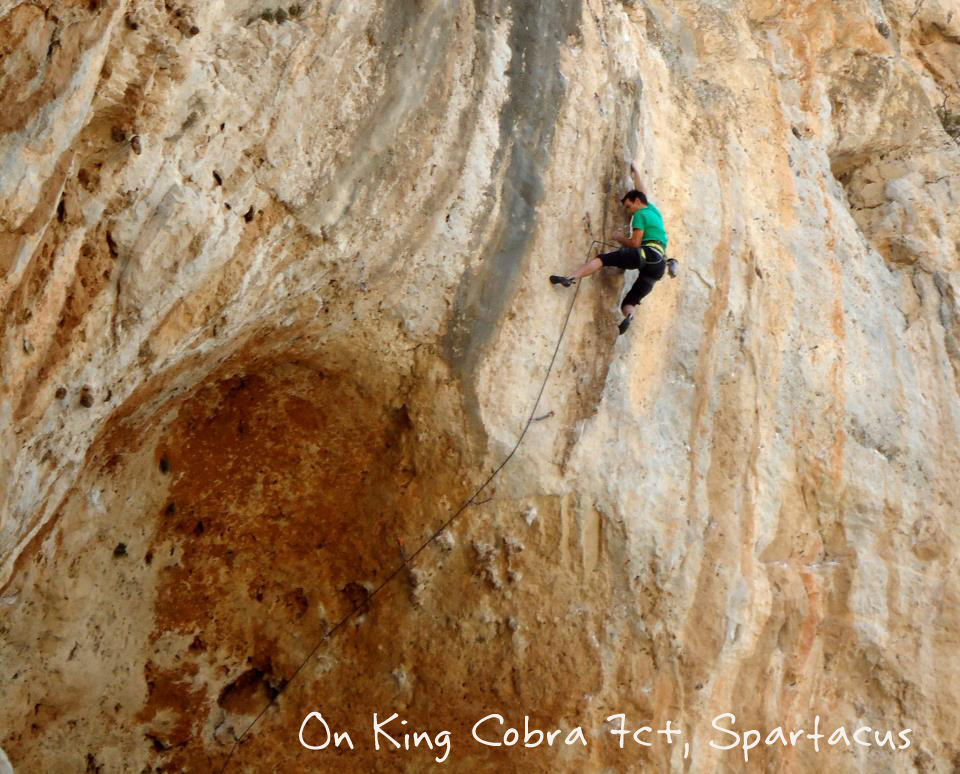
We do pre-work with our students to determine where their weaknesses lie before the camp, and help them with their goal-setting. Each day during the camp we all participate in a discussion module covering one key aspect of climbing performance, which helps provide a focus to the day's climbing. We constantly shoot video and conduct a video analysis session with each climber to help identify weak areas and analyse ways to improve. But mostly, it is the positive and supportive vibe of the team which sees each climber try a little harder and achieve more than they thought possible.

Most memorable routes you have climbed on Kalymnos (regardless of grade)?

    •    Axium 6c+, Ghost Kitchen
    •    Biloute 7a, Olympic Wall
    •    Aegialis 7c, Grande Grotta
    •    Zawi Nul Syndicate 7c/+, Grande Grotta
    •    Fun De Chichunne 8a, Grande Grotta
    •    Lucifer's Hammer 6c, Spartan Wall
    •    Phineas 5c, Symplegades
    •    Chameleon 8a, Spartacus
    •    And now for something completely different 5c, Arginonda
    •    Kerveros 7a, Spartacus

Some climbers may be worried about visiting Kalymnos due to the ongoing economic crisis in Greece. How did you experience Kalymnos this year? Was your stay in any way affected by the crisis compared to previous visits? What would you advise a first-time visitor to Kalymnos?

We weren't affected at all. There was some strike action during our stay but we luckily avoided it. A first time visitor should take a 70m rope and more quickdraws than they think they will need. Try every restaurant, and drink lots of frappes!

When will we see you in Kalymnos again?  

We never know for sure if we'll go again. And yet we always seem to find ourselves back in Masouri. It's beginning to feel like a second home. Who wants to help me get a Greek working visa? :)

Aris also has the interview online on his excellent ClimbKalymnos site.

Interview in Vertical Life


New online climbing mag Vertical Life has done an interview with me, basically checking in on my ascents of The Don 33 and Vicious Wishes 32.

The interview is up on their site, and you can download issue #1 for free there also.

Big ups to Simon Madden and Ross Taylor for forging ahead, sticking their necks out and essentially (virtually) self publishing something that is artistic and meaningful. It's completely congruent with the tagline of this website (look up top - my own personal mission).

I look forward to issue #2.

Thailand Thaitanium Project - 2012 Rebolting Report by Josh Lyons

This article is a follow-up report to the big and popular article from March 2011 called Titanium bolts: The answer for Thailand climbing? That article described the actions of the Thaitanium Project, a small crew of volunteers who are working their arses off rebolting the cliffs of Railay/Tonsai with titanium bolts, because this is one of the rare places in the world which causes stress corrosion cracking in stainless steel, leading to bolt failure.

Josh at Eagle Wall.
I got in touch with Josh Lyons in Tonsai, the man with the whip behind the Thaitanium Project to see how the 2012 rebolting push was progressing...

Lee: "Hey Josh. I see you're back in Thailand once again for the Thaitanium Project rebolting initiative. How many years have you guys been going back with the main focus of rebolting?"

Josh: "This is the second official year of the Thaitanium Project. Although they have been re-bolting with Titanium bolts for over 10 years now, we just never gave it a name. Back then I guess we still thought of Titanium bolts as just another experiment. After about five years in the rock the bolts still look like the day we put them in and that gave us a lot more confidence to continue to put in Titanium. It wasn't until the bolt price went through the roof that we started the project."

Lee: "My article from 2011 explained why we need titanium bolts in southern Thailand. Have you been told any scary stories from the past season?"

Stress corrosion cracking on a Fixe ringbolt.
Josh: "Unfortunately yes! We had a team of climbers on the big multipitch climbs on the Sleeping Indian Wall and broke bolts at a couple of the anchors. So back in the day, one of the methods of re-bolting with Titanium [bolts] when they were not readily available was to sometimes only put Titanium bolts at the crux of the pitch and one at the anchor. Of course with the idea that they would be re-bolted in the future. Unfortunately we have not gotten to them as of yet but they are high on the list for next year."

Lee: "So last year you guys had a focus of rebolting the entire sector of The Keep and you achieved that, and more. What is the goal for this year, and how is progress?"

Several generations of hardware on Greed 8c.
Newly placed Ti bolt on right. All other bolts
were later removed.
Josh: "Right, the idea last year was to experiment with doing both a kind of piecemeal method of only doing a few popular climbs at a bunch of areas and also the siege tactic of picking a crag and re-bolting the whole damn thing. The Keep was a huge success and it seems like folks really like the idea of having the whole area re-bolted so they don't have to think about anything but sending their project. As it turns out the siege method also makes the re-bolting logistically much easier. So this year we wanted to do the siege method on another crag which ended up being Eagle Wall. Luckily this year we raised enough money to buy another hammer drill. This meant that we could be re-bolting at two different locations at the same time. So along with the Eagle Wall we were able to do some piecemeal re-bolting and re-bolted Equatorial on Thaiwand Wall, a few routes on the Tyrolean Wall and Greed, which I believe is the hardest route in Thailand. All in all we placed around 300 bolts again this year."

Lee: "You're great at getting other random climbers involved in the initiative, and it's often under your guidance that people get their first taste of bolting. Passing on those skills must be satisfying? Have you got a good crew this year? What nationalities are represented?"

Will rebolt for beer.
Josh: "I do try to get volunteers but it is really nice to keep the crew small. Most of the folks that want to volunteer are people that have bolting experience or are in the rope access world. The people that approach me that want to get their first taste of bolting need to go through a few days of belaying and groundwork before they get to touch anything like the drill. For the most part once they see the process we go through day to day they start to realize or they remember themselves that it's kinda hard and they are on a holiday and call it good after about a half day. If they stick around for a while and get to actually do something like gluing or drilling they quickly realize that people are going to fall on these bolts and that they can't fuck this up. So the process itself weeds out the riff-raff and I am left with a good crew of folks that not only understand the importance of re-bolting this place but also the importance of doing it right.

Grinder time.
This year we were very lucky in that we had a lot of rope access folks. I can't say enough about how important it was to have these guys on the grinders. Nobody has ever done anything like this before so we have to figure a lot of this out as we go. Cutting the old bolts out is hands down the most dangerous part of the re-bolting process and to have guys that are used to having a two rope system and figuring it out on the fly was priceless!

This year again we had a very multicultural team with folks from Australia, Wales, Sicily, Sweden, England, Russia, Canada, Germany, Taiwan, Switzerland, USA, Cyprus, Norway and France."

Lee: "So how can you afford to do this? How much do the bolts cost, and where is the money coming from?"

Josh: "Well that is a good question. We can afford to do this because we have caring and generous folks out there that want to see Tonsai survive. We raised almost $2,000 last year from the DVD's, T-shirt sales and through donations. We also have teamed up with the American Safe Climbing Association (ASCA) www.safeclimbing.com who has very generously apportioned enough money to buy at least 200 of the bolts we get a year. This has freed up some money to purchase things like a new drill and a couple of angle grinders."

Lee: "How can people donate to the cause?"

Josh: "Folks who would like to donate to the cause can go to www.thaitaniumproject.com and using Paypal, they can donate directly to the project. This spring I will be working to get the film available for download off the same site. So stay tuned!"
Thanks Josh!

I think I speak for nearly all climbers when I say a big thank you to Josh and all the other climbers who have donated their time to help the cause. Rebolting is tiring, largely thankless work and these guys and gals are not being paid to do it. They could be mooching around and having a proper holiday. So give them some props and donate!

BUY TITANIUM BOLTS:

2013 update: If this article has you curious and you want to buy some of these amazing titanium bolts for your own routes and rebolting efforts, the guy to speak with is Martin Roberts who has now been producing and supplying the Thaitanium Project for the last few years. He now has a website where you can purchase his titanium bolts: http://www.titanclimbing.com/.


Climbkalymnos interviews Lee Cujes

Climbkalymnos.com, the premier site of all things Kalymnos just published an interview with me.

I talk about some random stuff, as well as the camps we ran in Kalymnos this year and why I reckon the place is so good.

Click this link to check it out.


Lee Cujes interview by Whipper Magazine

Whipper Online Climbing Magazine just published an interview with me on their site. I talk a little about my background in climbing and also about some of the climbing camps Upskill has been doing over the past few years, our upcoming camps and our plans for the future. Check it out!

Lee Cujes - Interview on Whipper Magazine (http://whipper.com.au)
(Edit: Whipper is unfortunately no longer operating)

Interview reproduced below:

Whipper tracked down Queenslander Lee Cujes who just won the lotto and is doing what everyone is dreaming about… sort of….

Whipper: Lee Cujes. Who are you? What do you do? And why?

I am a 32 year old climber from Brisbane in Queensland. I’ve been climbing for about 15 years and about four years ago my wife Sam and I started our own very small part-time business Upskill Climbing which is involved in training and coaching climbers, as well as running climbing camps. As for the why – hmm – good question! I seem to have boundless energy when it comes to climbing and I love sharing this and seeing others improve. I also love spending time with people who enjoy climbing as much as I do. I’ve been told I have a very natural teaching style, so I suppose a climbing coach is a good fit for me.

Whipper: How did you start climbing? Looking on the map you come from one of the hottest places in Australia, where the normal people do water sports.

Yeah. I even quit climbing a while back to focus on wakeboarding. It didn’t take though. The time off made me come back hungrier than ever for climbing. Queenslanders are lucky because in the last few years we’ve managed to find some spots in the shade that are climbable in summer. It might not always be pleasant, but it’s still climbing!

Whipper: Word on the street is that you just quit your job… did you win the lotto?

Lotto – I wish! Yeah, I saw the Five Ten ‘Quit Your Job’ ad and just went with it. I guess the whole “travel for a year as a climbing bum thing” is something that most climbers fantasise about. Being married, having mortgages to pay and a stable job, I had just assumed it would never happen for me; and to be honest, I was content as a weekend warrior with a perpetual annual leave balance of zero. Then Sam and I discussed what was really stopping us from taking a trip like this. Of course, all the barriers were in our heads, so we resolved to make it happen. We’re in month number two of 12 and we’re loving it!

Lee kicking the 9-5 for the read deal. Vietnam climbing at its best.
 Photo: Chris Glastonbury
Whipper: You seem to do a lot of sport climbing. Do you do much bouldering? And are you keen for any mountain stuff?

I grew up on trad (we didn’t have any sport routes in SE QLD when I started). I then developed a passion for doing new routes, both on trad, and later with a drill. Traveling to Europe as well as Nowra and the Blue Mountains really opened my eyes to the enjoyment of sport climbing and I’ve been pursuing this for years now. I still love new routes and am always looking for the next big thing. The only bouldering I do is on my home woody for training. I can’t seem to get psyched for boulders like I can for routes. But maybe one day that will change? I think I have a lot in common with dedicated boulderers. They’re seeking out purity of movement and sick hard sequences, and I’m doing the same, just on routes. As for mountains, I’ve done a few aid routes in Yosemite, but nothing alpine. I figure if I’m going to be cold, I might as well have a snowboard strapped to my feet. But, never say never! A lot of that alpine rock is super inspiring.

Whipper: Over the last few years it seems your climbing level has stepped up to the next level. What do you consider your best performance?

Mate, I’m a battler! My improvement since I started climbing has been very slow but very steady. In fact, each year for the last 10 years I have managed to incrementally improve. I will try hard to continue this for as long as I can. There was a time about five years ago when I changed my entire approach to training, and that made a big difference. I used to train on and off (perhaps going to the local gym once per week or something like that) and sure, I was seeing some improvements. But then I decided to add some structure to my training and put some rigor around my routine. Since then, I have noticed a significant improvement on the rock. I’m fascinated by training and I get almost as much joy out of the training and experimenting as I do from the climbing. I spend a lot of my spare time researching developments in training and working out ways I can apply them to my routine. My best performances so far have been first ascents and they are all unrepeated so who knows about the proposed grades, but things like Schadenfreude 31, Bite The Hand That Feeds 31, Below The Belt 31 and The Singularity 32 are routes that took lots of effort for me and are therefore the ones which are close to my heart. It seems the more effort I put in, the more rewarding the eventual send.

Whipper: Does Upskill Climbing Camps take people up Everest?

That would be scary! We stick to what we know, and that’s sport climbing. Did you see Everest was just summitted by a 13 year old? Can’t be that hard then, surely?

An Upskill Climbing Camp hanging out in the best training venue in the world. Kalymnos.
Whipper: I noticed on your web site http://www.upskillclimbing.com that you offer climbing camps with “Delicious breakfasts and dinners; packed lunches on climbing days”. Does that mean I get 2 minute noodles? Or roast beef for dinner? And as much beer as I can drink?


Lol! We do things pretty deluxe on the camps. We’re always joking that things have to be “world class” which is tongue in cheek, but also not. Team members can pretty much choose whatever they like, so mate if you want roast beef – you got it! May we also suggest the stuffed calamari, fresh fish of the day and the moussaka. And if you can still climb 100% the next day after drinking as much beer as you can drink, I doff my cap to you good sir.

Whipper: You have been around the world a couple of times or maybe more. Do you have any stand out cliffs that you could marry or have an affair with?

How good is Céüse? I’ve only been there once but that taste was unforgettable. I resolve here and now to go back there ASAP! You probably know I love Kalymnos (Greece) as I’m doing this interview from there and this is my third trip to this location. There’s still oodles to do here, and the whole Greek experience really appeals to me. And then there’s our very own Taipan Wall in the Grampians which is still the scene of some of my fondest climbs and memories.

Whipper: So Lee you have a climbing camp coming up at Maple Canyon in the USA. Can you give us a little beta on it?

Sure. Maple Canyon is one of the primo summer destinations in the USA for sport climbing and in August this is the place to be. It’s a really unusual conglomerate rock; you’re climbing almost exclusively on cobblestones. Every angle imaginable and a wide range of grades and shade! So we’re going a couple of weeks ahead of time to learn the area inside out, and then doing a sportclimbing camp for two weeks on location. If you enjoy camping, this is probably a good one to attend as it will be cheaper than normal (no fancy hotels), and there are some sub-$900 flights to the US available currently. Our camps essentially have the focus of getting a great group of people together, getting each other on the best routes at our level, sharing our collective knowledge and hopefully working through some of the weaknesses we all have in our climbing. We handle all the transport, food, logistics and admin. You just relax, socialise and climb lots. People can check out more about the camps on the website. There’s trip reports, picture galleries and videos from all the previous camps too.
Lee passing on his knowledge during a Upskill Climbing Camp.
Whipper: You seem to be doing a lot of these training camps. Do you do them in Australia? And where will they be after Maple Canyon?

Yeah this will be the sixth one we’ve done so far. We’ve done one based on a houseboat on the Hawkesbury River in NSW which was super good fun, and I’m sure we’ll look at other unusual Aussie options in 2011 and beyond. I’m most keen to deliver things that are perhaps not so easy for someone to just organise themselves; something a bit special or uncommon, or something where the group really makes the difference (like deep water soloing in Vietnam which we did last year). After Maple in August, we have a camp in Spain’s amazing sportclimbing area of Rodellar in late September which we already have people signed up for (with spaces available). Rodellar is one of the world’s top rated sport areas, so I’m pretty psyched!

Whipper: Upskill Climbing camps seem to be getting bigger and better. Where will Upskill Climbing camps be in five years?

Yeah, things have ramped up this year for sure. I can’t imagine doing this full time, but in a couple of years I can envisage running perhaps four camps per year to various destinations. We are slowly growing our pool of dedicated trip participants, and I look forward to meeting and climbing with more people as word slowly gets around. We’ve been extremely lucky thus far to have participants who have been super psyched, safe, solid individuals and we’re good friends with all of them now. This model seems to be serving us well.

Whipper: Most people are in the rat race or a stuck in it. What advice would you give someone that is in that situation?

I don’t necessarily think the rat race or a full time job is a bad thing. Working five days a week makes you hungry for climbing and you can use this passion to your advantage. Just don’t make excuses. Own your life; your situation. Don’t say you don’t have time to train or climb. You have chosen to prioritise something over training or climbing. Own that decision. If something is truly important to you, you will make time. Do you actually need to work five days a week or could you get by on four? Negotiate flexible working arrangements or extra holidays at half pay. And if you want to do a big trip, save some money, pack your stuff in boxes, put it in a storage shed, rent your house and get on a plane. It really is that easy. Life’s short, so you better do what you want to do now and don’t put it off.

Whipper: Anyone you would like to thank?

I would like to thank my regular climbing partner of many years Duncan Steel who mentored me and taught me a lot of the things I now take for granted about climbing hard routes. I’d also like to thank my amazing clients who give me at least as much psyche as I give them. And finally Sam who is not only the logistical brains behind our business but also the catalyst behind this whole crazy adventure when she asked me, “Why don’t we just do it?”. I’m thankful every day.

__________________________

Whipper: Thanks heaps Lee! Whipper wishes you and Sam all the best and is so psyched that you are trying to help Australian climbing go forward!


If you haven’t checked out Lee’s site you should! If you have any questions about the climbing camps I am sure Lee will be more than happy to answer them.


Interview with Rodney Polkinghorne

Rodney Polkinghorne is a SEQ based climber who has over the last year or so done what many climbers find impossible to do: bust through the plateau and take his climbing to the next level. How you ask? Well, that's what we're going to find out.


Rodney on Screaming Insanity (26), Mt Coolum, Queensland, Australia. © E Laliberte 2009

Lee: "So Rod, congrats on a great season. Tell us what kind of climbing you were doing a year or two ago, and what you've been doing this season."

"Thanks Lee. I was stuck at grade 21 from 2002 until 2006, but since then I've progressed faster each year. At the end of 2007 I sent Brisbane Bitter, Blackheathen and Jacqueline Hyde, all 24, and Hung Like a Fruit Bat, which is a straightforward 25. The only tick that stands out from 2008 is Child in Time, the classic 22 at Frog, which was a messy send after many attempts. This year, I climbed Worrying Heights (24) at Frog, and I passed the entrance exam for Mt Coolum, Screaming Insanity (26)."

Lee: "Can you put your finger on what it was that was holding you back? Was it mental or physical?"

"My limits were mental. I was always a hesitant climber - I'd do a move, and stop to psyche myself up. Then a bunch of my friends got hurt. By early 2008, five had been seriously injured while climbing, and two had died in other outdoor pursuits. I stopped trusting myself, because I'd trusted some of those people completely. I placed quickdraws then climbed down and jumped off, because I expected to slip while clipping them. I spent minutes worrying about each piece of protection. When I couldn't see anything wrong, I expected something weird to happen. I couldn't let go of the consequences and focus on climbing, which you must do to push your limit on lead."

Lee: "The more I coach the more I see headspace and mental limitations being the primary thing holding climbers back. So were you consciously aware of this as a limiting factor at the time? What allowed you move beyond this? Was it a breakthrough moment like turning on a light switch, or a long incremental grind?"

"I was a bold and committed leader when I started, in 2001 and 2002. I climbed grade 21 at Frog and Moonarie when I'd been climbing for a year and a half. So I knew how I wanted to climb, and how far I was from it.

"One thing that turned me around was Arno Ilgner's book (The Rock Warrior’s Way). His message is that being afraid and wimping out are just habits, and so are commitment and focus, so you can train to be bold and determined. Ilgner gives some exercises for that, which are the best part of the book.

"The UQ climbing club helped a great deal, too. They kept telling me that I could climb much harder if I pushed myself, and eventually I believed it.

"I've had both long grinds and moments of enlightenment. To stop being distracted by thoughts of falling, I had to climb above gear and let go of dozens of times. My progress wasn't so much incremental as stationary - each time, I just didn't want to do it. Then one day I started up my warm-up route, didn't think about falling at all, and it stopped being a problem. The breakthroughs come in their own time, but they only came after a lot of frustrating practice."

Lee: "So if you had to give some advice to climber who was in the same position as you (held back by their fear on the sharp end), what would you say?"

"Go out with bolder climbers. The more you see people fall without hurting themselves, or pull through easy but run out climbing, the less you believe those things are impossibly dangerous. You start wondering how you can do them, not whether you can do them.

"Keep reminding yourself why you want to climb well. Often, you know that you could go for it and fall off safely, but you don't want to. It helps to remind yourself that one day you're going to pull the lip of Kachoong, you want to be relaxed enough to enjoy it, and pushing yourself now will contribute to that - or something along those lines. Once you start to push yourself, your lead head will improve."

Lee: What does the future hold for Rodney's climbing?

"Right now, I'm ready to go long and wild in Girraween and the Warrumbungles. Changes of focus keep me keen. I still have dreams of climbing real mountains, but I'm having too much fun rockclimbing to pursue them. There are so many classics to do at grades 25 and 26!"

Lee Cujes interview by Pinnacle Sports

Pinnacle Sports interviews me in 2006 for their website...

Q1:
Where did you start to climb and at what age did it become more than the next sport on the list of things to try?

Lee: I started climbing in 1994. I was 17. Went to a climbing gym a few times (thanks Mum!) and was hooked, and started venturing outdoors. This was before climbing info was available on the internet. We had to work out everything ourselves, which meant rope was purchased from the hardware store, the same 8mm poly rope you use on your trailer. We made harnesses out of the same rope using a soldering iron. The exceedingly painful G-string configuration we came up with led to some seriously bruised kidneys. We used D-shackles to belay. Our first outdoor climbing was at the Daisy Hill State Forest quarry. I went back there a few years ago and was astounded by how chossy the walls were that we managed to get up. It's amazing none of us got badly injured, but I think when you don't know anything at all and don’t really have any confidence in your gear, you place a lot more emphasis on being absolutely sure of your safety. Beginners these days can get pretty cavalier which can lead to accidents.

Q2: I have no idea what your accomplishments have been lately so let’s start there. What have you been on?

Lee: Well, I started the year off by getting engaged in Thailand on New Years Day; also getting in a bunch of good climbing including my first 8a/29 (Just Call Me Helmet - second shot) and 7b+/26 flash (No Have). In March I managed a flying visit to Taipan Wall in the Grampians where I sent Anaconda and Venom (both 28, third shot) and World Party (27) as well as a stack of other great climbs. Taipan was great! Then my latest Easter trip was to the Blue Mountains where I did three 25's, a 26 and three 27's (all first or second shot) and had five attempts on Self Portrait (29), getting it down to one fall. Locally, I recently climbed all the routes and link-up's on Upper Slider Wall including Gareth's 27 Hybrid Vigour, and added The Forty Metre Mile (28) with Duncan Steel. A few weeks ago I did the first known free ascent of Ricochet at Serpent, proposing 27 for it.

Q3: What was the inspiration for pushing the grade this year? Was the idea to improve your onsight level?

Lee: Like a lot of people, I'm interested in simply improving my climbing. One aspect of that is climbing harder (which usually means harder grades). The inspiration for climbing harder has been that I've become really interested in training, and I've been keen to see whether training does pay off. Now that I think about it, that sounds back to front.

I'm certainly keen on onsighting and always have been. If I think I have a good shot on a route I will always try to go for the onsight. You've only ever got one chance at this, so why not go for it? I'm still looking forward to my first grade 26 onsight!

Q4: Climbing trad has been a great focus of yours at Frog Buttress last season, do you feel that trad has given you an edge on the latest ticks in the Blueies?

Lee: To be honest, I didn't really do a lot of true trad climbing last season, although I did tick some of the harder Frog routes (three 27's). These were done with the protection in place, whether placed by someone else on a previous attempt or by rapping in and pre-placing. I don't count this as trad climbing; it's sport climbing a trad route. Some people get very aggressive about ethics and tactics, but my focus is to climb the route. As long as you're honest with yourself and others, I don't see the problem. Also, the majority of the hard routes (27+) at Frog were originally yo-yo'd, meaning the gear was left in place from previous attempts. One day if I want to better my style, I can try doing them ground-up placing the gear. The thing climbing harder routes at Frog did do for me was provide a motivational boost. It boosted my self confidence, and allowed me to take myself seriously when thinking about climbing hard routes. As Duncan says, it's like unlocking a door. You tick one, and you can keep ticking them.

You asked about whether climbing trad helps with sport climbing. Probably not! The best thing for sport climbing is sport climbing, and the same goes for all other climbing disciplines.

Q5: What is involved in your training and prep for hard climbs? You seem to be ticking every trip you go on. What’s the secret?

Lee: No secrets! Self-evaluation is the key. I ask myself "why did I fall off that climb?" The answer might be because I got pumped and my hands opened up on a pretty big hold. Therefore I need to train my endurance. There are certain exercises or training drills you can do for endurance, so I schedule them in (see my article on training diaries). When the time comes to try the route again I can see whether the training paid off, and what else I might need to train.

Q6: Where do you see your climbing going over the next few months, are there any trips and goals we should look out for?

Lee: Well, I’ll be going out to Frog a bit more as the weather cools down. I was out there the weekend before last and did all the moves on the Trousers, so that’s now firmly in my mind to do. I must admit though, I’m one of the few climbers who don’t gush about Frog. I keep telling people – it’s not climbing. It’s something but it’s not climbing. Climbing is grabbing holds and pulling on them. You can do entire routes at Frog without ever grabbing a hold. I'm also proposing a name change from Frog Buttress to Mank Buttress. Hopefully it'll catch on - tell your friends.

This weekend coming I’m off to Nowra for a flying long-weekend visit. So that’ll be good. It’d be good to try a few things around the 27/8 mark. Apart from that, I’ve also got my hand in the development of a new crag. The first route is complete, and there’s scope for quite a few more. Hopefully people will enjoy them once they’re done.

Sounds good. Keep us updated.

Lee: Will do, thanks Chris.

Interview by Chris Trengove, Pinnacle Sports