Thailand Thaitanium Project - 2012 Rebolting Report by Josh Lyons

This article is a follow-up report to the big and popular article from March 2011 called Titanium bolts: The answer for Thailand climbing? That article described the actions of the Thaitanium Project, a small crew of volunteers who are working their arses off rebolting the cliffs of Railay/Tonsai with titanium bolts, because this is one of the rare places in the world which causes stress corrosion cracking in stainless steel, leading to bolt failure.

Josh at Eagle Wall.
I got in touch with Josh Lyons in Tonsai, the man with the whip behind the Thaitanium Project to see how the 2012 rebolting push was progressing...

Lee: "Hey Josh. I see you're back in Thailand once again for the Thaitanium Project rebolting initiative. How many years have you guys been going back with the main focus of rebolting?"

Josh: "This is the second official year of the Thaitanium Project. Although they have been re-bolting with Titanium bolts for over 10 years now, we just never gave it a name. Back then I guess we still thought of Titanium bolts as just another experiment. After about five years in the rock the bolts still look like the day we put them in and that gave us a lot more confidence to continue to put in Titanium. It wasn't until the bolt price went through the roof that we started the project."

Lee: "My article from 2011 explained why we need titanium bolts in southern Thailand. Have you been told any scary stories from the past season?"

Stress corrosion cracking on a Fixe ringbolt.
Josh: "Unfortunately yes! We had a team of climbers on the big multipitch climbs on the Sleeping Indian Wall and broke bolts at a couple of the anchors. So back in the day, one of the methods of re-bolting with Titanium [bolts] when they were not readily available was to sometimes only put Titanium bolts at the crux of the pitch and one at the anchor. Of course with the idea that they would be re-bolted in the future. Unfortunately we have not gotten to them as of yet but they are high on the list for next year."

Lee: "So last year you guys had a focus of rebolting the entire sector of The Keep and you achieved that, and more. What is the goal for this year, and how is progress?"
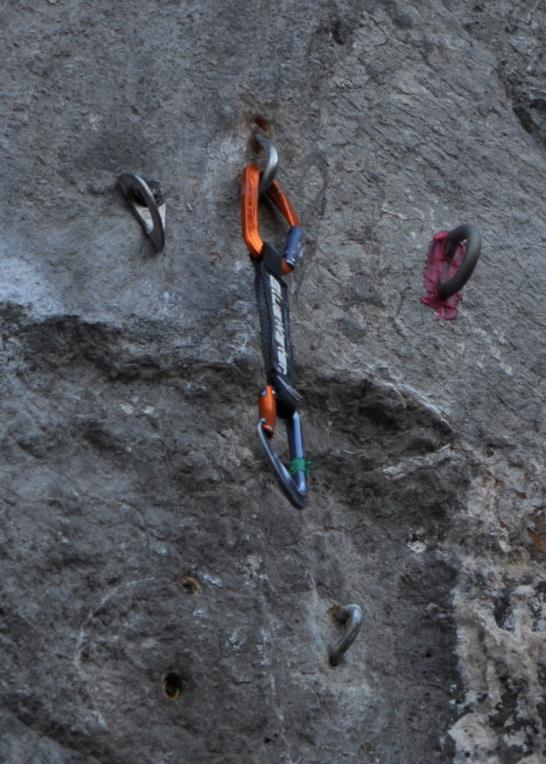
Several generations of hardware on Greed 8c.
Newly placed Ti bolt on right. All other bolts
were later removed.
Josh: "Right, the idea last year was to experiment with doing both a kind of piecemeal method of only doing a few popular climbs at a bunch of areas and also the siege tactic of picking a crag and re-bolting the whole damn thing. The Keep was a huge success and it seems like folks really like the idea of having the whole area re-bolted so they don't have to think about anything but sending their project. As it turns out the siege method also makes the re-bolting logistically much easier. So this year we wanted to do the siege method on another crag which ended up being Eagle Wall. Luckily this year we raised enough money to buy another hammer drill. This meant that we could be re-bolting at two different locations at the same time. So along with the Eagle Wall we were able to do some piecemeal re-bolting and re-bolted Equatorial on Thaiwand Wall, a few routes on the Tyrolean Wall and Greed, which I believe is the hardest route in Thailand. All in all we placed around 300 bolts again this year."

Lee: "You're great at getting other random climbers involved in the initiative, and it's often under your guidance that people get their first taste of bolting. Passing on those skills must be satisfying? Have you got a good crew this year? What nationalities are represented?"

Will rebolt for beer.
Josh: "I do try to get volunteers but it is really nice to keep the crew small. Most of the folks that want to volunteer are people that have bolting experience or are in the rope access world. The people that approach me that want to get their first taste of bolting need to go through a few days of belaying and groundwork before they get to touch anything like the drill. For the most part once they see the process we go through day to day they start to realize or they remember themselves that it's kinda hard and they are on a holiday and call it good after about a half day. If they stick around for a while and get to actually do something like gluing or drilling they quickly realize that people are going to fall on these bolts and that they can't fuck this up. So the process itself weeds out the riff-raff and I am left with a good crew of folks that not only understand the importance of re-bolting this place but also the importance of doing it right.

Grinder time.
This year we were very lucky in that we had a lot of rope access folks. I can't say enough about how important it was to have these guys on the grinders. Nobody has ever done anything like this before so we have to figure a lot of this out as we go. Cutting the old bolts out is hands down the most dangerous part of the re-bolting process and to have guys that are used to having a two rope system and figuring it out on the fly was priceless!

This year again we had a very multicultural team with folks from Australia, Wales, Sicily, Sweden, England, Russia, Canada, Germany, Taiwan, Switzerland, USA, Cyprus, Norway and France."

Lee: "So how can you afford to do this? How much do the bolts cost, and where is the money coming from?"

Josh: "Well that is a good question. We can afford to do this because we have caring and generous folks out there that want to see Tonsai survive. We raised almost $2,000 last year from the DVD's, T-shirt sales and through donations. We also have teamed up with the American Safe Climbing Association (ASCA) www.safeclimbing.com who has very generously apportioned enough money to buy at least 200 of the bolts we get a year. This has freed up some money to purchase things like a new drill and a couple of angle grinders."

Lee: "How can people donate to the cause?"

Josh: "Folks who would like to donate to the cause can go to www.thaitaniumproject.com and using Paypal, they can donate directly to the project. This spring I will be working to get the film available for download off the same site. So stay tuned!"
Thanks Josh!

I think I speak for nearly all climbers when I say a big thank you to Josh and all the other climbers who have donated their time to help the cause. Rebolting is tiring, largely thankless work and these guys and gals are not being paid to do it. They could be mooching around and having a proper holiday. So give them some props and donate!

BUY TITANIUM BOLTS:

2013 update: If this article has you curious and you want to buy some of these amazing titanium bolts for your own routes and rebolting efforts, the guy to speak with is Martin Roberts who has now been producing and supplying the Thaitanium Project for the last few years. He now has a website where you can purchase his titanium bolts: http://www.titanclimbing.com/.


Ask The Coach #6: Training Series 1/3: Beating the pump!

In this quarter's issue of ROCK Magazine, I begin the first of a three-part training series on the main building blocks you need to address as part of a yearly training plan.

In this case, because it's the first one we're starting with the building blocks and that is ARC (Aerobic Restoration and Capillarity) training and PE (Power Endurance) training.

If you want to beat the pump, this is required reading.

Click to view bigger.
Stay tuned for parts two and three!

Mere Mortal's Guide to Beasting the Beastmaker 45° Slopers

The Beastmaker 2000 is a wooden hangboard produced by a couple of lads in the UK and is now available worldwide. It's good. I've posted about it before. My board was in the first shipment to hit Australia back in 2009.

Anyway let's get down to business. You're reading this because you are a mere mortal like me and the Beastmaker slopers feel impossible to hang.

Beastmaker 2000 has three sloper angles: 20°, 35° and 45°.

Beastmaker 2000 grip layout
I naturally favour an open-hand grip and avoid crimps (opposite of most people) so when I got my board I could immediately do a couple of chinups on the 35° slopers. Some people I coach who are good climbers struggle to even hang these. Don't worry if this is you.

In your quest for the 45° chinup, you'll need to get comfortable on the 35°'s. 

Before doing anything
  • Warm up thoroughly. If I go to my board now and try to hit the slopers I will immediately fall off. They'll feel impossible. It is vital to warm up these grips. Do some bouldering. Use easier grips like the 20° sloper. Spend 20 minutes or so building up the squeeze you're going to need.

Cheating

  • Nestling your fingers into the ridges, using your thumb, or any other kind of malarky to provide assistance is only cheating yourself. I also find that it doesn't help with progression on the slopers. Follow my guide below instead.

Grip on the 45°s
A word on grip
  • I always thought maximising the amount of skin on the wood was the key to success. However, as soon as I begun work on the 45°s, I realised that the best grip was two pads only as shown above.

Stage 1
  • 5 chinups on the 20° sloper. Should be easy for most climbers.

Stage 2 - Beasting the 35°'s
  • Deadhang the 35° slopers. If you're struggling, put one hand on the 20° and the other on the 35°. Hang this for as long as you can, then switch. You'll notice a tendency to barndoor as you do this because the grip on the 20° is much stronger than the grip on the 35°. Control this!
  • Once deadhangs are no problem, start chinups. You will find it is hardest to control the down part of the motion. Make sure you have a mat under your board as you could fall hard on your tailbone.
  • Work up to about 5 very controlled chinups (in a row). Once you're at this point you're ready for Stage 3.

Stage 3 - The Dreaded 45°s!
  • You're not going to be able to deadhang the 45°s straight away. So we are going to share grips. One hand on a 35°, the other on the 45°. Deadhang, and twirl off gracefully (you'll see what I mean). Now swap. You're building up the squeeze power on the 45°s.
  • Mixed-grip chinups. One hand on a 35°, the other on the 45°. Chinup (and down) cleanly. Swap.
  • Multiple mixed-grip chinups. One hand on a 35°, the other on the 45°. Chinup (and down) cleanly TWICE. You're now on the cusp, hang in there. Once you can do THREE of these it's time. Get the video camera.
  • Chinup the 45°s. You'll most likely slip off on the way back down. Keep at it and nail your first clean 45° chinup! FEEL THE POWER! Now update your Facebook status.


How often? How long?
  • Let motivation be your guide. One or two sessions a week, with your other climbing and training should do it. From the point when I could do a handful of clean chinups on the 35°s, I was 10 sessions away from my first 45° chinup (doing 1-2 sessions a week). I was doing a fairly standard hangboard session (crimps, pockets etc.) with slopers thrown in at the end. Your mileage may vary. Let me know if this works for you.

Board/skin prep
  • Get a big soft brush for brushing slopers between each attempt. Like a dustbin brush. Really helps.
  • Chalk up, wipe off any excess, then breathe hot warm air onto your fingers.

Humidity
  • In a stark opposite to regular rock climbing, humidity makes a HUGE difference - it's good! If it is cold and dry you are going to struggle your arse off. I did my first 45 chinup in pouring rain, 100% humidity and high temperature. I was training regularly and keeping notes, and this humidity manifested in ridiculous personal bests on the board.

Different boards
  • I am assured that well-loved boards (UK Climbing Works) are waaaay easier to use the slopers on. Oils exuding from people's skin seep into the wood and affect friction. By all accounts, The Works' board is sticky.
  • As you can imagine, 1° makes a big freakin difference. If you or someone else has installed the board on a surface that isn't exactly plumb, you're going to be in trouble, either in a good or bad way. Use an angle-finder to measure your slopers and ensure they're spot on.

If you have any other great sloper tips or frictional insights, please share in the comments.